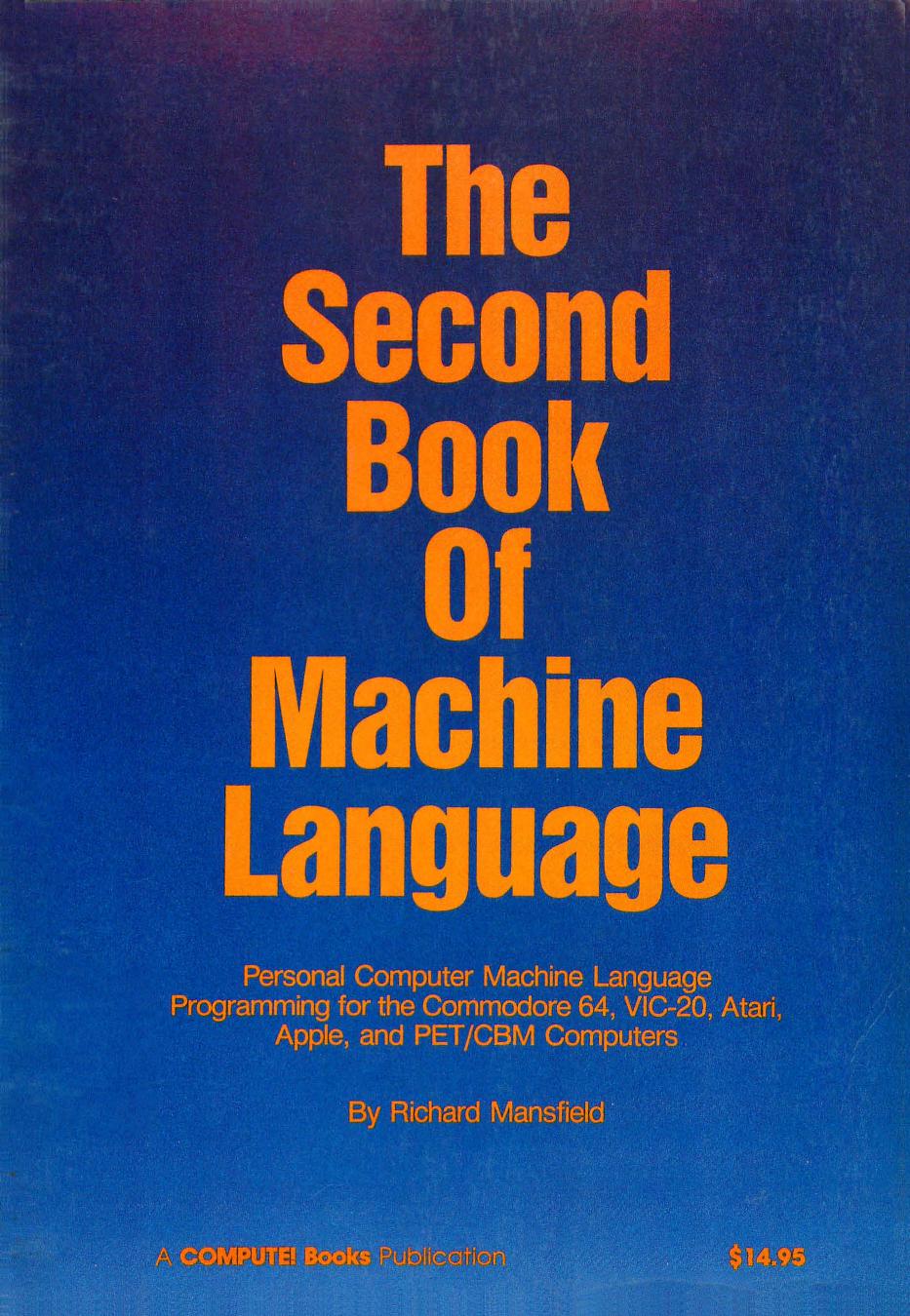
The Second Book of Machine Language by Unknown
Author:Unknown
Language: eng
Format: epub, pdf
Tables: Data, Messages, Variables
Notice the relationship between LDA (15,X) and LDA #15. The former has an opcode of 161; the latter, 169. As the Eval subprogram goes through the source code line, it is looking for clues to the addressing mode: Is there a #, a comma, a parenthesis, an X, or a Y?
Each of these things, combined with the TYPE, tells Eval when to raise the value of the original opcode (let's call it the base opcode) assigned to the mnemonic from the OPS table. If Eval finds a # symbol, it adds 8 to the base opcode and goes right to the TWOS exit. It knows then that this opcode should be 169 (161 + 8) and that there will be two bytes to assemble: Immediate mode addressing uses two bytes. (All the other mnemonics grouped with LDA as type 1 will also add 8 to their base opcodes to signify their Immediate addressing modes.)
The base opcodes are in that third table called OPS (190). The Eval subprogram looks up each mnemonic in the MNEMONICS table, and then the numbers extracted from the TYPES and OPS tables are stored in the variables TYPE and OP for future reference. Finally, Eval starts looking for those # and ) clues within the source code line. These clues cause Eval to add 4 or 8 or 16 or sometimes even 24 to the base opcode. This adjusts the base opcode upward so it will eventually become the correct opcode for the addressing mode being used.
CMP is grouped with LDA as a type 1 mnemonic. That's because a # will add 8 to either of their base opcodes and result in the correct, final opcode for Immediate addressing. The base opcode for CMP is 193, which, unadjusted, would stand for CMP (15,X). If we come upon a # following the CMP, however, 8 is added to the 193, giving 201, the correct opcode for CMP #15. Then Eval would JMP to TWOS and conclude assembly of that line of source code.
In each case, the base opcode in the OPS table is the lowest possible opcode number from among the addressing mode options available to each mnemonic. As the evaluation process proceeds throughout the Eval subprogram, the discovery of the various addressing modes triggers additions to the base opcode. In the end, when Eval finally releases a source code line, the right opcode has been achieved.
Returning to the data within the Tables subprogram, we next come upon the little HEXA table (270). It lists all the digits found in hexadecimal numbers. It's used as a lookup table
Tables: Data, Messages, Variables
when LADS translates an internal two-byte integer into a printable, readable ASCII hexadecimal number like F-F-D-2.
The Six Bufferettes
Here are the buffers (290-340). They are constantly being filled with a source code line, evaluated, and then cleaned off by being filled with zeros. They are separated into six different bufferettes primarily for the programmer's benefit. It's easier to visualize different actions if the buffers have different names.
Download
The Second Book of Machine Language by Unknown.pdf
This site does not store any files on its server. We only index and link to content provided by other sites. Please contact the content providers to delete copyright contents if any and email us, we'll remove relevant links or contents immediately.
The Mikado Method by Ola Ellnestam Daniel Brolund(25281)
Hello! Python by Anthony Briggs(24334)
Secrets of the JavaScript Ninja by John Resig Bear Bibeault(23419)
Kotlin in Action by Dmitry Jemerov(22503)
The Well-Grounded Java Developer by Benjamin J. Evans Martijn Verburg(21959)
Dependency Injection in .NET by Mark Seemann(21837)
OCA Java SE 8 Programmer I Certification Guide by Mala Gupta(20704)
Algorithms of the Intelligent Web by Haralambos Marmanis;Dmitry Babenko(19517)
Grails in Action by Glen Smith Peter Ledbrook(18594)
Adobe Camera Raw For Digital Photographers Only by Rob Sheppard(17028)
Sass and Compass in Action by Wynn Netherland Nathan Weizenbaum Chris Eppstein Brandon Mathis(15836)
Secrets of the JavaScript Ninja by John Resig & Bear Bibeault(13683)
Test-Driven iOS Development with Swift 4 by Dominik Hauser(11850)
Jquery UI in Action : Master the concepts Of Jquery UI: A Step By Step Approach by ANMOL GOYAL(11151)
A Developer's Guide to Building Resilient Cloud Applications with Azure by Hamida Rebai Trabelsi(10621)
Hit Refresh by Satya Nadella(9185)
The Kubernetes Operator Framework Book by Michael Dame(8562)
Exploring Deepfakes by Bryan Lyon and Matt Tora(8400)
Robo-Advisor with Python by Aki Ranin(8358)
